
Small Business Website Appalachia
Small Business Website Appalachia
Why Every Small Business in Appalachia Needs a Professional Website in 2027
From the mountains of West Virginia to the growing communities throughout Kentucky, Virginia, Tennessee, Ohio, and beyond, small businesses need more than word-of-mouth to compete. Here’s how the right domain name, professional website, and reliable web hosting can help your business grow.
Imagine someone searching Google for the exact service your business provides. They’re ready to make a purchase, schedule an appointment, or request a quote.
Your business has exactly what they’re looking for.
But there’s one problem: they can’t find you online.
This is a situation many small businesses face every day. Whether you operate a family-owned restaurant, construction company, automotive repair shop, landscaping business, retail store, or professional service, having a professional website is becoming an essential part of doing business.
Across Appalachia, entrepreneurs and small business owners are building companies, creating jobs, and serving their communities. A professional website gives those businesses another way to reach customers, showcase their work, and compete in an increasingly digital marketplace.
The good news? Building a website doesn’t have to be complicated or expensive.
With the right domain name, reliable web hosting, and easy-to-use website tools, you can establish an online presence that works for your business around the clock.
Here’s why your business needs a website in 2026 and how to get started.
1. Your Customers Are Searching for Businesses Like Yours on Google
Think about the last time you needed a plumber, electrician, restaurant, mechanic, or contractor.
Did you ask someone for a recommendation? Perhaps.
But there’s a good chance you also searched Google.
Your potential customers are doing exactly the same thing.
People routinely use search engines to find local businesses, compare services, read reviews, and locate contact information. If your business doesn’t have a website, you’re missing an opportunity to provide those customers with information about what you offer.
A professional website gives visitors a place to:
Learn about your company.
Explore your products and services.
View photographs of completed projects.
Read customer testimonials.
Find your business hours and contact information.
Request estimates or schedule appointments.
Learn why they should choose your business.
Your website can also support your local search visibility when combined with accurate business information, a properly maintained Google Business Profile, and useful content.
Want to learn more about getting found online?
Read Google’s official SEO Starter Guide for practical information about helping search engines understand your website.
2. Your Domain Name Is Your Business’s Digital Identity
Before you build a website, you need an address where customers can find it.
That’s where a domain name comes in.
A domain name is your unique address on the internet. For example, AppalachiaDomains.com gives customers a recognizable way to find Appalachia Domains online.
Your domain name becomes part of your business identity. It can appear on business cards, advertisements, vehicle graphics, invoices, social media profiles, and professional email addresses.
Choosing the right domain name is an important first step.
How to choose a good domain name
Consider these tips:
Keep it simple: Choose something customers can easily remember.
Make it recognizable: Use your business name whenever possible.
Avoid unnecessary complexity: Too many hyphens, numbers, or unusual spellings can make a domain difficult to remember.
Think about the future: Choose a name that can grow with your business.
Register your brand: Consider securing relevant domain variations to help protect your online identity.
A .COM domain remains a familiar choice for many businesses, although other extensions may be appropriate depending on your organization and goals.
You can explore different extensions and search for available names through our Domain Registration Services.
Ready to see whether your business name is available?
Visit Appalachia Domains and start searching for your perfect domain name.
3. A Professional Website Builds Customer Confidence
Would you feel comfortable hiring a company if you couldn’t find any information about it online?
Most customers want to know who they’re doing business with before making a decision.
A professional website helps establish credibility by showing visitors that your business has a legitimate online presence.
It also gives you control over how your company is presented.
Consider including these important website pages:
Home Page: Introduce your business and immediately explain what you offer.
About Us: Tell your story. Explain who you are, what you do, and why customers should choose your company.
Products and Services: Clearly describe what you sell or the services you provide.
Contact Us: Make it easy for customers to call, email, or request information.
Testimonials: Share genuine feedback from satisfied customers.
Frequently Asked Questions: Answer common questions before customers need to contact you.
The U.S. Small Business Administration offers helpful guidance in its article, 5 Essential Pages for Your Small Business Website.
A well-organized website makes it easier for customers to understand your business and take the next step.
4. Your Website Can Work for You 24 Hours a Day
Your physical business may close at 5 p.m., but your website never has to.
Customers can visit your website at any time, even when you’re sleeping, working in the field, or spending time with your family.
Imagine a homeowner looking for a roofing contractor at 10 p.m.
Your website can provide information about your services, display completed projects, answer frequently asked questions, and provide a way to request an estimate.
Or imagine someone looking for a restaurant on Sunday morning.
Your website can display your menu, hours, location, and contact information.
You can also add features such as:
Online appointment scheduling.
Contact and quote request forms.
Online product catalogs.
E-commerce shopping carts.
Frequently asked questions.
Newsletter subscriptions.
These features help make your website more than an online advertisement. It becomes a useful business tool.
5. Choosing the Right Web Hosting Matters
Registering a domain name gives your website an address, but web hosting provides the space and infrastructure needed to make your website accessible online.
Choosing the right hosting service is an important decision.
Not every business needs the same hosting solution.
At Appalachia Domains, we offer different hosting options to accommodate different website requirements.
Shared cPanel Hosting
Shared hosting is a popular starting point for small businesses, personal websites, and blogs.
It provides an affordable way to establish an online presence without having to manage an entire server.
Our Shared cPanel Hosting Plans include an easy-to-use control panel that helps you manage website files, databases, and other hosting features.
WordPress Hosting
WordPress is one of the world’s most widely used website platforms.
It allows business owners to create everything from simple informational websites to sophisticated online stores.
Our WordPress Hosting Plans are designed for customers who want to build and manage WordPress websites.
Depending on the selected plan, features include WordPress installation, backups, SSL, and website security tools.
VPS and Business Hosting
As your business grows, your website requirements may change.
Businesses with more demanding applications, higher traffic, or specialized server requirements may benefit from additional resources and flexibility.
Explore our Business and VPS Hosting Options to learn more about the hosting solutions available through Appalachia Domains.
The important thing is choosing hosting that fits your website today while giving you room to grow tomorrow.
6. You Don’t Need to Know How to Code to Build a Website
One of the biggest misconceptions about building a website is that you need to be a computer programmer.
That simply isn’t true.
Modern website-building tools make it possible for individuals and small business owners to create attractive websites without writing complicated code.
With a website builder, you can:
Choose a professionally designed template.
Customize colors and fonts.
Add your business logo.
Upload photographs.
Create service pages.
Add contact information.
Make your website mobile-friendly.
Appalachia Domains offers an Easy Website Builder that helps customers create websites using customizable designs.
You can focus on your business instead of spending all your time learning website development.
Whether you’re starting a new business or updating an older website, a website builder can help simplify the process.
7. Website Security Is Something Every Business Should Take Seriously
Your website represents your business. Protecting it should be a priority.
Cybersecurity problems can affect businesses of every size. Small businesses are not immune to malware, compromised passwords, malicious traffic, or website vulnerabilities.
Fortunately, there are practical steps you can take to reduce your risks.
Start with an SSL certificate
An SSL certificate helps encrypt information exchanged between your website and its visitors.
Websites protected by HTTPS display a secure connection in modern browsers.
Explore our SSL Certificate Services to learn more about protecting your website connection.
Consider website security and firewall protection
A website firewall can help identify and filter potentially harmful traffic before it reaches your website.
Appalachia Domains offers Website Security and Firewall Solutions to help website owners strengthen their online protection.
Don’t overlook website backups
Imagine spending months building your website, adding photographs, writing articles, and developing your online presence, only to lose everything because of a technical problem.
A reliable backup strategy can make a significant difference.
Regular backups provide recovery options if something goes wrong.
Learn more about our Website Backup and Restore Services.
For additional information, WordPress provides an excellent guide explaining how to back up a WordPress website.
Remember that website security involves several layers. SSL, backups, software updates, strong passwords, and security monitoring all play important roles.
8. Professional Email Makes Your Business Look More Established
Your business email address is another important part of your online identity.
Consider the difference:
Personal email: yourbusiness123@gmail.com
Professional email: info@yourbusiness.com
Both addresses can send and receive messages, but a custom email address using your business domain creates a consistent professional image.
Professional email can help you:
Establish credibility with customers.
Maintain consistent business branding.
Create separate addresses for different departments.
Communicate with suppliers and business partners.
Keep business communications organized.
For example, a company might use:
Appalachia Domains offers Professional Email Services and Microsoft 365 solutions to help businesses manage professional communications.
Your domain name can do more than direct customers to your website. It can become part of your entire business communication system.
9. A Website Gives Your Business Room to Grow
Your business might start with a simple five-page website, but there’s no reason it has to stay that way.
As your company grows, your website can grow with it.
You might eventually add:
An online store.
Customer account portals.
Online booking.
A company blog.
Product catalogs.
Downloadable resources.
Customer support pages.
Online payment options.
You can also publish helpful articles that answer questions your customers frequently ask.
For example:
A roofing company could publish an article about choosing the right roofing materials.
A landscaping company could write about preparing lawns for spring.
A restaurant could share recipes, event announcements, and menu updates.
A contractor could explain the steps involved in planning a home renovation.
This type of content gives customers useful information while helping establish your business as a knowledgeable resource.
Google recommends creating helpful, reliable, people-first content rather than publishing material solely to manipulate search rankings.
You can read Google’s Creating Helpful, Reliable, People-First Content guide for additional recommendations.
10. Why Small Businesses Across Appalachia Should Invest in Their Online Presence
Appalachia has a tremendous variety of businesses, industries, and entrepreneurs.
From family-owned shops in small towns to growing companies in larger communities, local businesses deserve the opportunity to compete online.
A professional website can help connect businesses with customers beyond their immediate neighborhoods.
It can help a West Virginia contractor showcase projects to customers in surrounding counties.
It can help a Kentucky retailer display products to shoppers who may never have visited the physical store.
It can help a Virginia service provider explain its services to potential customers before they ever pick up the phone.
An online presence isn’t limited by the same geographic boundaries as a traditional storefront.
That’s one of the biggest opportunities available to small businesses today.
Appalachia Domains is proud to support businesses and creators throughout the Appalachian region and beyond with domain registration, web hosting, website-building tools, security, and professional email solutions.
Your Small Business Website Launch Checklist
Thinking about building a website? Here are ten things to consider before launching.
Choose a memorable business domain name.
Register your domain before someone else does.
Select a web hosting plan that fits your needs.
Choose a website platform or website builder.
Create a professional homepage.
Add clear descriptions of your products and services.
Include your business contact information.
Install an SSL certificate and plan for website security.
Set up regular website backups.
Make sure your website works properly on mobile devices.
Once your website is published, continue improving it. Add useful content, update your business information, and monitor how visitors find and use your website.
Frequently Asked Questions About Small Business Websites
How much does it cost to build a small business website?
The cost depends on the domain name, hosting plan, design, features, and whether you build the website yourself or hire a professional.
A simple informational website can be much less expensive than a custom website with advanced functionality.
Starting with an affordable domain and hosting plan is a practical way to get online without committing to a large initial investment.
Do I need a domain name before purchasing web hosting?
Not necessarily. However, having your domain name selected and registered gives you a recognizable online address.
Domain registration and web hosting are separate services. You can register your domain first and connect it to your hosting account when you’re ready.
Learn more about domain registration.
Is WordPress good for small businesses?
Yes. WordPress is a flexible website platform that can support business websites, blogs, portfolios, and online stores.
Its themes and plugins allow you to customize your website as your business grows.
You can explore WordPress Hosting from Appalachia Domains.
What is the difference between a domain name and web hosting?
Your domain name is your website’s address. Web hosting provides the server resources and infrastructure that make your website available online.
You generally need both to operate a traditional website using your own domain.
Do I need an SSL certificate?
An SSL certificate enables HTTPS encryption, helping protect information exchanged between your website and visitors.
HTTPS is an important security standard for modern websites.
Can I build a website without coding experience?
Absolutely. Website builders and content management systems such as WordPress allow people to create and manage websites without having to write code.
Why should my business have a professional email address?
A professional email address using your own domain helps establish consistent branding and makes your company communications look more established.
Explore Professional Email Services.
Take the First Step Toward Growing Your Business Online
Your business has a story worth sharing.
You have products, services, experience, and knowledge that potential customers are looking for. A professional website gives you a place to bring all those things together.
You don’t need to be a technology expert. You don’t need a huge marketing department. And you don’t have to figure everything out on your own.
You just need to take the first step.
At Appalachia Domains, we’re here to help individuals, entrepreneurs, and small businesses establish and grow their online presence.
Explore our services:
Visit AppalachiaDomains.com today and start building your online presence.
Your next customer could be just one Google search away.
Appalachia Domains — Your Journey Starts with a Domain Name.
Share:

More Posts
Small Business Website Appalachia
Why Every Small Business in Appalachia Needs a Professional Website
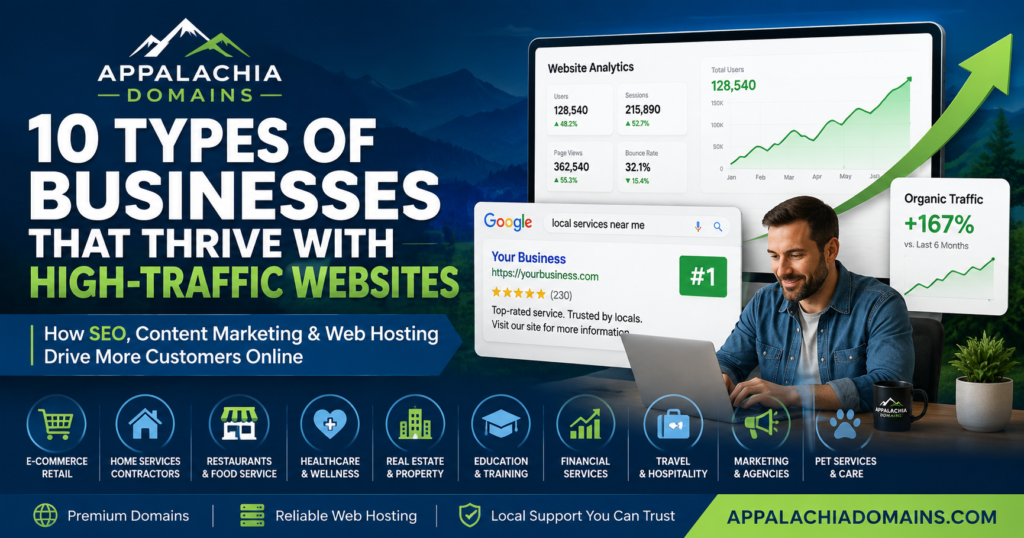
10 Types of Businesses That Thrive With High-Traffic Websites
10 Types of Businesses That Thrive With High-Traffic Websites In

Web Hosting in West Virginia: The Small Business Guide to Choosing the Best Local Service
When you are running a business in the Mountain State,

What Is Web Hosting? A Simple Guide for Small Businesses
What Is Web Hosting? A Simple Guide for Small Businesses

Ten Reasons To Do Business with Appalachia Domains
Ideal for Small Businesses & Startups Local Roots. Reliable Results.
New England & Northern Region
- Connecticut
- Maine
- Massachusetts — Berkshires
- New Hampshire — White Mountains
- Vermont — Green Mountains
Mid-Atlantic Region
- New Jersey — Northern Ridges
- New York — Catskills and surrounding Appalachian areas
- Pennsylvania — Allegheny Mountains and Appalachian Plateau
- Maryland — Western Maryland mountain region
Central & Southern Region
- Alabama — northern foothills and Appalachian extensions
- Georgia — North Georgia mountains
- Kentucky — Appalachian Plateau and eastern mountain region
- North Carolina — Blue Ridge Mountains and Mount Mitchell
- Ohio — eastern and southeastern Appalachian Plateau
- South Carolina — Upstate mountain foothills
- Tennessee — Smoky Mountains and Cumberland Plateau
- Virginia — Blue Ridge Mountains and Shenandoah region
- West Virginia — entirely within the Appalachian Regional Commission region
For the official 13-state Appalachian Regional Commission region, visit the Appalachian Regional Commission.